Pardillo Sizerín
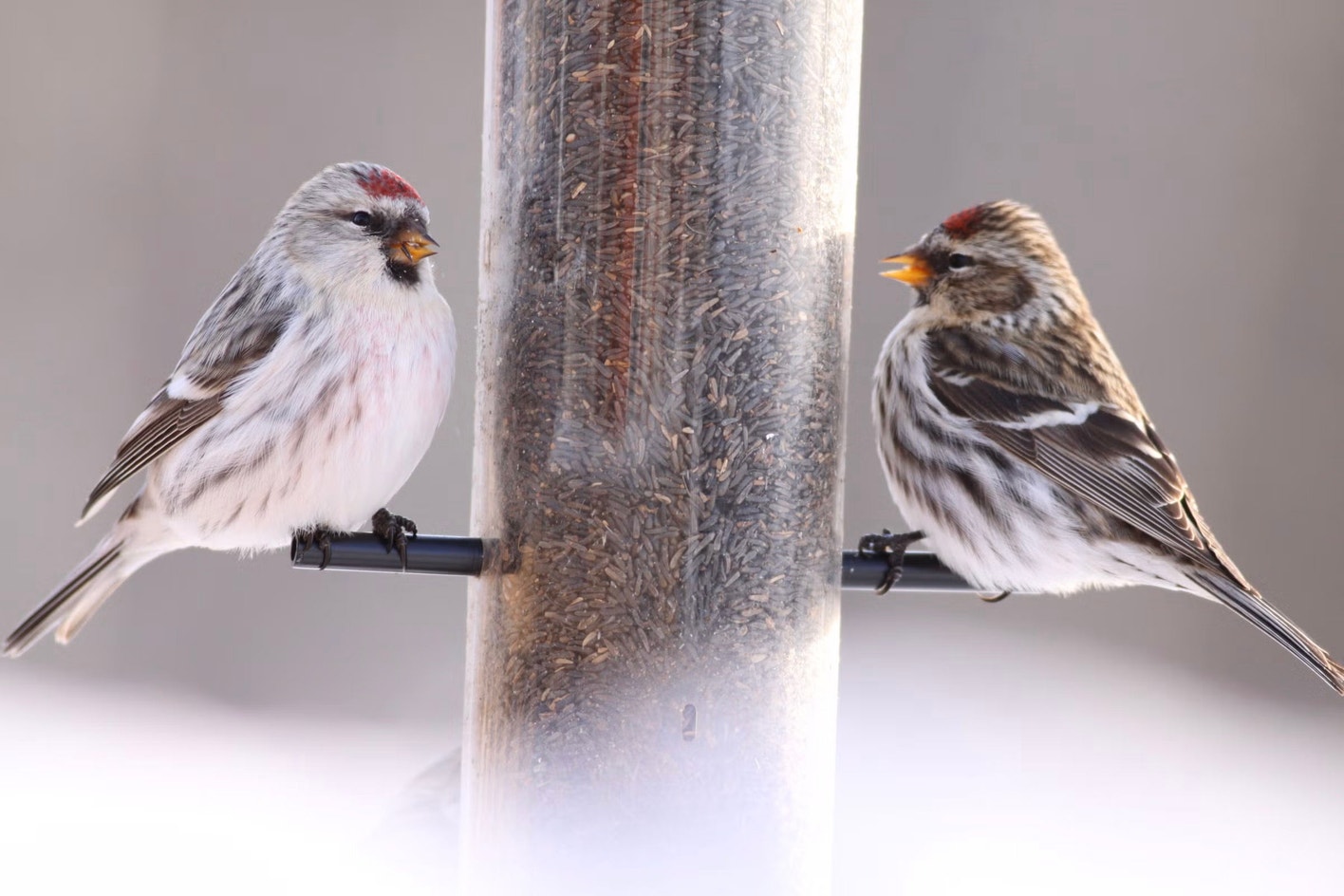














Pardillo Sizerín
Acanthis flammea
A simple vista
One of the 'winter finches,' nesting in the Arctic and sometimes invading southern Canada and the northern states. Redpolls are tiny, restless birds, feeding actively on seeds among trees and weeds, fluttering and climbing about acrobatically, their flocks seemingly always on the move. At bird feeders in winter, Redpolls are often remarkably tame. For their small size, they have a remarkable ability to survive cold temperatures; their southward flights are sparked by the temporary scarcity of food in the North, not by cold. The northernmost breeding populations are noticeably paler and were formerly separated as a distinct species, Hoary Redpoll. Although they tend to stay farther north, a few of these paler birds may be mixed in with winter Redpoll flocks visiting southern Canada and the northern states.
Todo el texto de la guía de aves y los mapas de distribución fueron adaptados de Lives of North American Birds de Kenn Kaufman© 1996, utilizado con permiso de Houghton Mifflin Harcourt Publishing Company. Reservados todos los derechos.
Categoría
Finches, Perching Birds
IUCN Status
Least Concern
Hábitat
Campos, prados y praderas, Bosques y bosques, Humedales de agua dulce, Arbustas, sabanas y matorrales, Tundra y hábitats boreales
Región
Alaska y el norte, Este de Canadá, Grandes Lagos, Atlántico Medio, Nueva Inglaterra, Noroeste, Grandes Llanuras, Montañas Rocosas, Sureste, Suroeste, Oeste de Canadá
Comportamiento
Rareza, Baras de ala rápidas, Ondulado
Población
275.000.000
Rango e identificación
Mapa de migración y distribución
The Redpoll migrates by day, in flocks. Very irregular in winter range, probably moving only as far south as necessary to find food.
Descripción
Both sexes — Length: 4.5–5.5 in (12–14 cm); wingspan: 8–10 in (20–25 cm); weight: 0.3–0.7 oz (9–20 g). The Redpoll is small, with a red forehead, a black chin, and a yellow bill. Darker overall in summer. Male has a variable pink wash on the chest. Compare Redpoll to House Finch and other red finches.
Tamaño
About the size of a Sparrow
Color
Negro, Marrón, Rosa, Rojo, Blanco
Forma de alas
Pointed
Forma de cola
Notched, Square-tipped
Cantos y llamadas
Patrón de canto
Flat, Rising
Tipo de canto
Chatter, Chirp/Chip, Trill, Whistle
Hábitat
Birches, thickets, tundra scrub. In winter, weeds, brush. The Redpoll breeds in shrubby habitats of the North, including clearings in birch or spruce forest, thickets of willow, alder, or dwarf birch, and bushy areas on tundra. Winters in various kinds of semi-open country, including woodland edges and brushy or weedy fields.
Suscríbase al boletín de Audubon para obtener más información sobre aves como el Pardillo Sizerín
Comportamiento
Huevos
4-5, rarely up to 7. Pale green to blue-green, with purplish to reddish brown spots often concentrated at the larger end. Incubation is by female only, about 10-11 days. The male Redpoll feeds the female during incubation.
Cría
Fed mostly by female; contribution by male varies. Young leave the nest about 12 days after hatching.
Comportamiento alimentario
The Redpoll forages very actively in trees, shrubs, weeds, and on the ground. Except when nesting, it usually forages in flocks. Has a pouch within its throat where it can store some food for up to several hours; this helps the bird in bitterly cold weather, allowing it to feed rapidly in the open and then digest food over a long period while it rests in a sheltered spot.
Dieta
Mostly seeds, some insects. The Redpoll's diet for most of the year is mainly seeds and other vegetable matter. Feeds on catkins, seeds, and buds of willows, alders, and birches, small conifer seeds, and also seeds of many weeds and grasses. Also eats insects, mainly in summer.
Nidificación
Male Redpolls dominate females in winter flocks, but as breeding season approaches, females become dominant and may take the lead in courtship. Does not seem to defend much of a nesting territory; nests of different pairs may be close together. Nest: Usually very well hidden in dense low shrubs, within a few feet of the ground, sometimes in grass clumps or under brushpiles. Nest (probably built by female) is an open cup of fine twigs, grass, moss, lined with feathers (especially ptarmigan feathers), plant down, or animal hair.
Vulnerabilidad
Estado de conservación
Still widespread and abundant.
Amenazas climáticas que enfrenta el Pardillo Sizerín
Elija un escenario de temperatura a continuación para ver qué amenazas afectarán a esta especie de ave a medida que aumente el calentamiento global. Las mismas amenazas impulsadas por el cambio climático que ponen en riesgo a las aves afectarán también a otras especies de vida silvestre y a las personas.
