Rufous Hummingbird
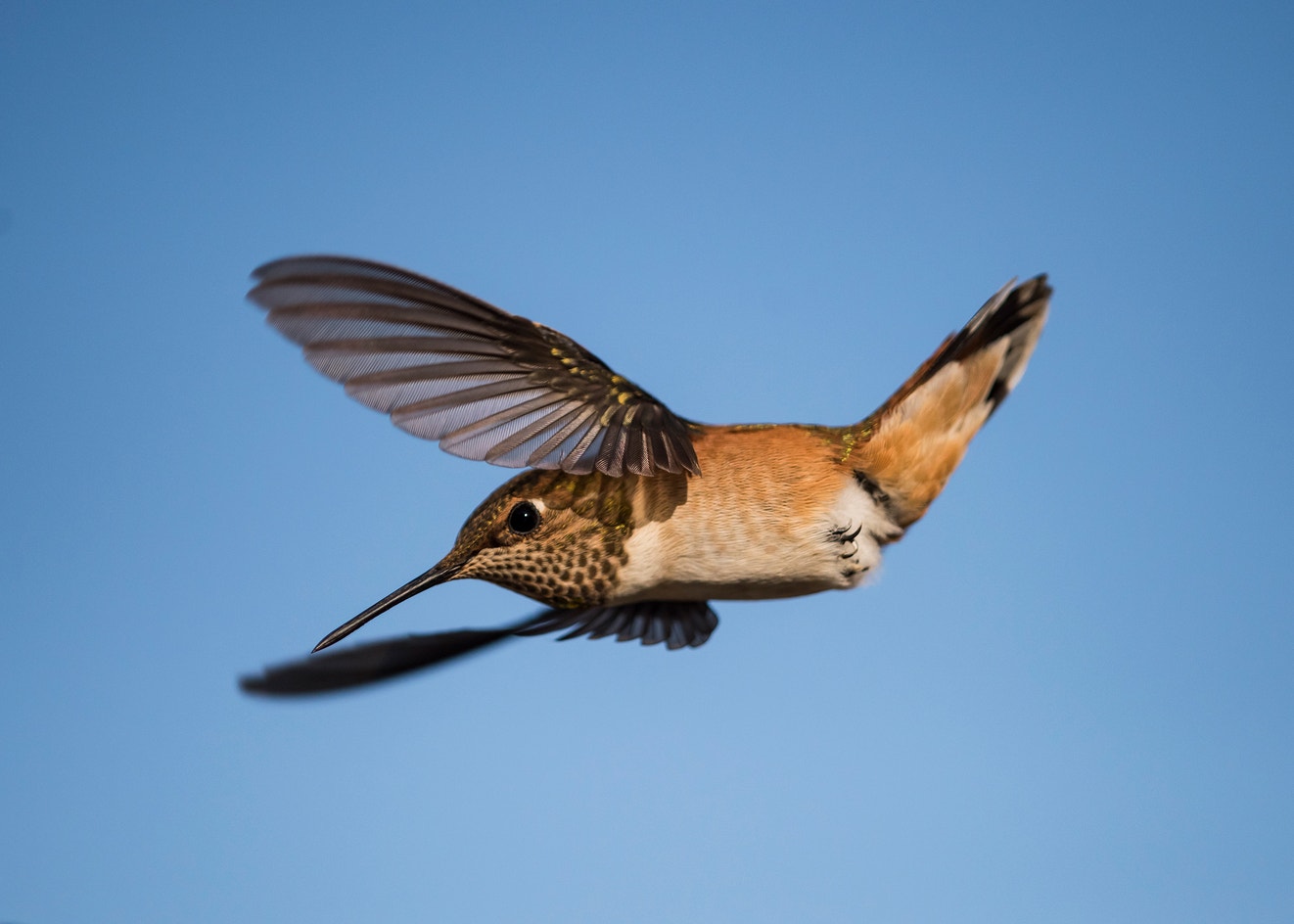













Rufous Hummingbird
Selasphorus rufus
At a Glance
Although it is one of the smaller members in a family of very small birds, the Rufous Hummingbird is notably pugnacious. The male Rufous Hummingbird, glowing like a new copper penny, often defends a patch of flowers in a mountain meadow, vigorously chasing away all intruders (including larger birds). This hummingbird also nests farther north than any other species: up to south-central Alaska. Of the various typically western hummingbirds, the Rufous Hummingbird is the one that wanders most often to eastern North America, with many now found east of the Mississippi every fall and winter.
All bird guide text and rangemaps adapted from Lives of North American Birds by Kenn Kaufman© 1996, used by permission of Houghton Mifflin Harcourt Publishing Company. All rights reserved.
Category
Hummingbirds
IUCN Status
Near Threatened
Habitat
Arroyos and Canyons, Coasts and Shorelines, Desert and Arid Habitats, Forests and Woodlands, High Mountains, Shrublands, Savannas, and Thickets, Urban and Suburban Habitats
Region
Alaska and The North, California, Florida, Mid Atlantic, New England, Northwest, Plains, Rocky Mountains, Southeast, Southwest, Texas, Western Canada
Behavior
Flitter, Hovering, Rapid Wingbeats
Population
22.000.000
Range & Identification
Migration & Range Maps
The Rufous Hummingbird moves northwest in early spring mostly through Pacific lowlands and moves southeast beginning in late June, mostly through the Rocky Mountain region. Adult males migrate slightly earlier than females or young, and all migrate individually. Strays occur widely in the east, and many now winter regularly in the Gulf Coast states.
Description
Sexes similar — Length: 2.8-3.5 in (7-9 cm); wingspan: 4.3 in (11 cm); wight: 0.1-0.2 oz (2-5 g). The Rufous Hummingbird adult male is bright coppery rufous above, with a dark throat that shines red in good light. Females and young have a green back, a spotted throat, and an orange-buff wash on their sides and at the base of their tail.
Size
About the size of a Sparrow
Color
Black, Green, Orange, Red, White
Wing Shape
Narrow, Rounded, Short
Tail Shape
Multi-pointed, Notched, Rounded, Square-tipped
Songs and Calls
An abrupt, high-pitched zeee; various thin squealing notes.
Call Pattern
Flat
Call Type
Chirp/Chip, Trill
Habitat
Rufous Hummingbirds prefer forest edges, streamsides, mountain meadows. Breeding habitat includes forest edges and clearings, and brushy second growth within the region of northern coast and mountains. Winters mostly in pine-oak woods in Mexico. Migrants occur at all elevations but more commonly in lowlands during spring, in mountain meadows during late summer and fall.
Sign up for Audubon's newsletter to learn more about birds like the Rufous Hummingbird
Behavior
Eggs
2, rarely 1-3. White. Incubation is by female only, 15-17 days.
Young
Female Rufous Hummingbird feed young by sticking her bill deep into their mouths and regurgitating tiny insects, perhaps mixed with nectar. Age of young at first flight about 21 days.
Feeding Behavior
The Rufous Hummingbird usually feeds at flowers while hovering, extending its bill and long tongue deep into the center of the flower. At feeders, it may either hover or perch. To catch small insects, it may fly out and capture them in midair, or hover to pluck them from foliage. The Rufous Hummingbird also sometimes will take spiders or trapped insects from spider webs.
Diet
Mostly nectar and insects. The Rufous Hummingbird takes nectar from flowers and will feed on tiny insects as well. Often visits red tubular flowers such as penstemons, red columbines, paintbrush, scarlet sage, gilia, and many others. Will also feed on sugar-water mixtures in hummingbird feeders.
Nesting
The male Rufous Hummingbird's courtship display flight traces a steep U or vertical oval, climbing high and then diving steeply, with whining and popping sounds at the bottom of the dive. He also buzzes back and forth in front of a perched female. The male may mate with several females. The nest site is usually well concealed in the lower part of coniferous trees, deciduous shrubs, and vines. It is located 3-30 feet above the ground, usually lower than 15 ft, although nests may be higher later in the season. Old nests may be refurbished and reused. The nest, built by the female, is a compact cup of grasses, moss, plant down, spider webs, and other soft materials, with the outside camouflaged with lichens and moss.
Conservation
Conservation Status
Still widespread and very common, but the Rufous Hummingbird faces continuing declines in numbers during recent decades. Because it relies on finding the right conditions in so many different habitats at just the right seasons during the year, it could be especially vulnerable to the effects of climate change.
Climate Threats Facing the Rufous Hummingbird
Choose a temperature scenario below to see which threats will affect this species as warming increases. The same climate change-driven threats that put birds at risk will affect other wildlife and people, too.
