Common Loon
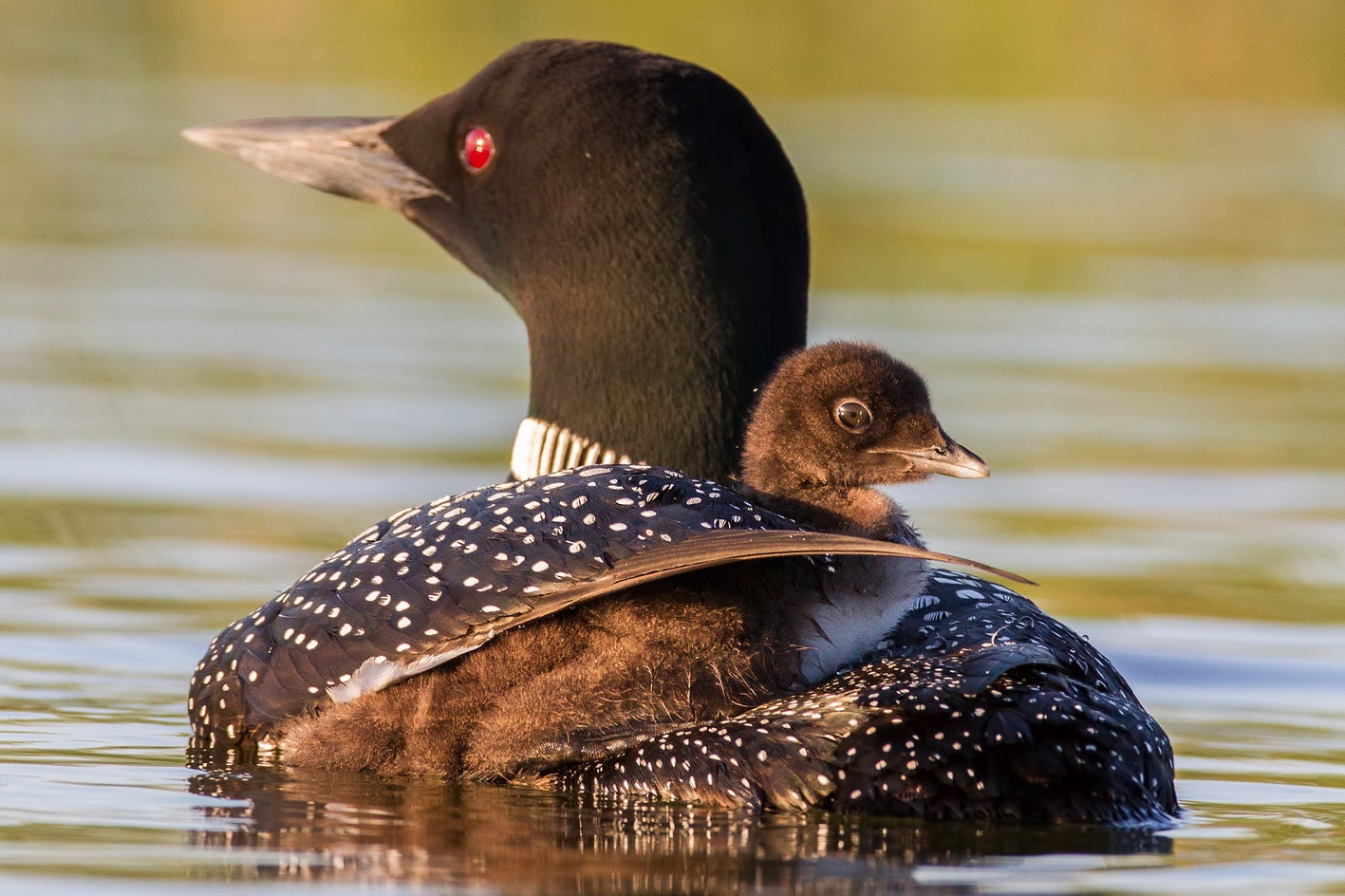


















Common Loon
Gavia immer
At a Glance
A long-bodied, low-slung diver. Many people consider the loon a symbol of wilderness; its iconic yodeling and haunting calls, heard by day or night, are characteristic sounds of early summer in the north woods and across lakes. In winter, silent and more subtly marked, the Common Loon inhabits coastal waters and large southern lakes. In such places they are solitary while feeding but may gather in loose flocks at night. The Common Loon is an indicator of aquatic health.
All bird guide text and rangemaps adapted from Lives of North American Birds by Kenn Kaufman© 1996, used by permission of Houghton Mifflin Harcourt Publishing Company. All rights reserved.
Category
Duck-like Birds, Loons
IUCN Status
Least Concern
Habitat
Coasts and Shorelines, Forests and Woodlands, Lakes, Ponds, and Rivers, Open Ocean, Saltwater Wetlands, Tundra and Boreal Habitats
Region
Alaska and The North, California, Eastern Canada, Florida, Great Lakes, Mid Atlantic, New England, Northwest, Plains, Rocky Mountains, Southeast, Southwest, Texas, Western Canada
Behavior
Direct Flight, Rapid Wingbeats, Swimming
Population
1.200.000
Range & Identification
Migration & Range Maps
In coastal areas, migrates singly or in small flocks just offshore, often low over water; usually flies higher when migrating over land. Large numbers may pause in migration on Great Lakes and other inland waters.
Description
Sexes similar; male slightly larger — Length: 2 ft 2 in-3 ft (66-91 cm); wingspan: 4 ft 2 in-4 ft 11 in (1.3 -1.5 m); weight: 5 lb 8 oz-14 lb (2.5-6.4 kg). The Common Loon is unmistakable in elegant summer plumage, with black head, black-and-white striped collar, and boldly checkered back. Resembles other loons in winter; note thick bill, wedges of dark and light pattern at base of neck, pale areas around eye and pale collar. Young birds in first winter have pale scaly back pattern.
Size
About the size of a Heron, About the size of a Mallard or Herring Gull
Color
Black, Gray, Green, White
Wing Shape
Narrow, Pointed, Tapered
Tail Shape
Short
Songs and Calls
Best-known call is a loud, wailing laugh, also a mournful yodeled oo-AH-ho with middle note higher, and a loud ringing kee-a-ree, kee-a-ree with middle note lower. Often calls at night and sometimes during migration.
Call Pattern
Complex, Rising, Undulating
Call Type
Odd, Scream, Yodel
Habitat
Wooded lakes, tundra ponds, coastal waters. In summer mainly on lakes in coniferous forest zone, also beyond treeline onto open tundra. Chooses large lakes with ample room for takeoff and with good supply of small fish. In winter mainly on ocean, usually fairly shallow waters close to shore; also on large lakes and reservoirs that remain ice-free.
Sign up for Audubon's newsletter to learn more about birds like the Common Loon
Behavior
Eggs
1-2, rarely just 1. Olive to brown with black or brown spots. Incubation by both sexes (the female may do more), 26-29 days.
Young
The young Common Loon leaves nest within 1 or 2 days after hatching, can dive and swim underwater at 2-3 days. Young are tended and fed by both parents; when small, sometimes ride on parents' backs. Capable of flight at about 12-13 weeks after hatching, but may be 2-3 weeks sooner in the upper Midwest of the United States. 1 brood per year.
Feeding Behavior
The Common Loon forages by diving and swimming underwater, propelled mainly by feet. Before diving, may swim and feed on surface schooling fish with head forward and partly submerged to peer underwater. Small fish swallowed underwater, larger items brought to surface and eaten there.
Diet
Mostly small fish. Includes fish up to about 10 in long such as minnows, suckers, perch, gizzard shad, rock cod, killifish, many others. Also crustaceans, mollusks, aquatic insects, leeches, frogs. Sometimes aquatic plants such as pondweeds and algae.
Nesting
Apparently first breeds at age of 2 years. Nesting territory claimed by "yodeling" song, also by flying in circles over territory with loud calls. In courtship displays, pairs dip bills in water repeatedly; rear up to vertical posture with wings partly spread; race side by side across surface of water. Nest: Built by both sexes. Site always very near water, on island or shore, partly hidden by surrounding vegetation. Nest, often re-used from year to year, is a mound of grasses, twigs, reeds.
Conservation
Conservation Status
Overall, the Common Loon is of least concern given its widespread distribution and increasing population sizes. However, it is considered sensitive in the northwestern United States and is currently listed as Threatened in Michigan and New Hampshire. The Common Loon has disappeared from some former nesting areas owing to human disturbance on lakes in summer; acid rain may also reduce food supplies in breeding range. Also been protected on some breeding grounds in the northeast by volunteer "Loon Rangers" who patrol the lakes and help to educate the public about conservation. Projected to lose much of its breeding range as a result of climate change.
Climate Threats Facing the Common Loon
Choose a temperature scenario below to see which threats will affect this species as warming increases. The same climate change-driven threats that put birds at risk will affect other wildlife and people, too.
